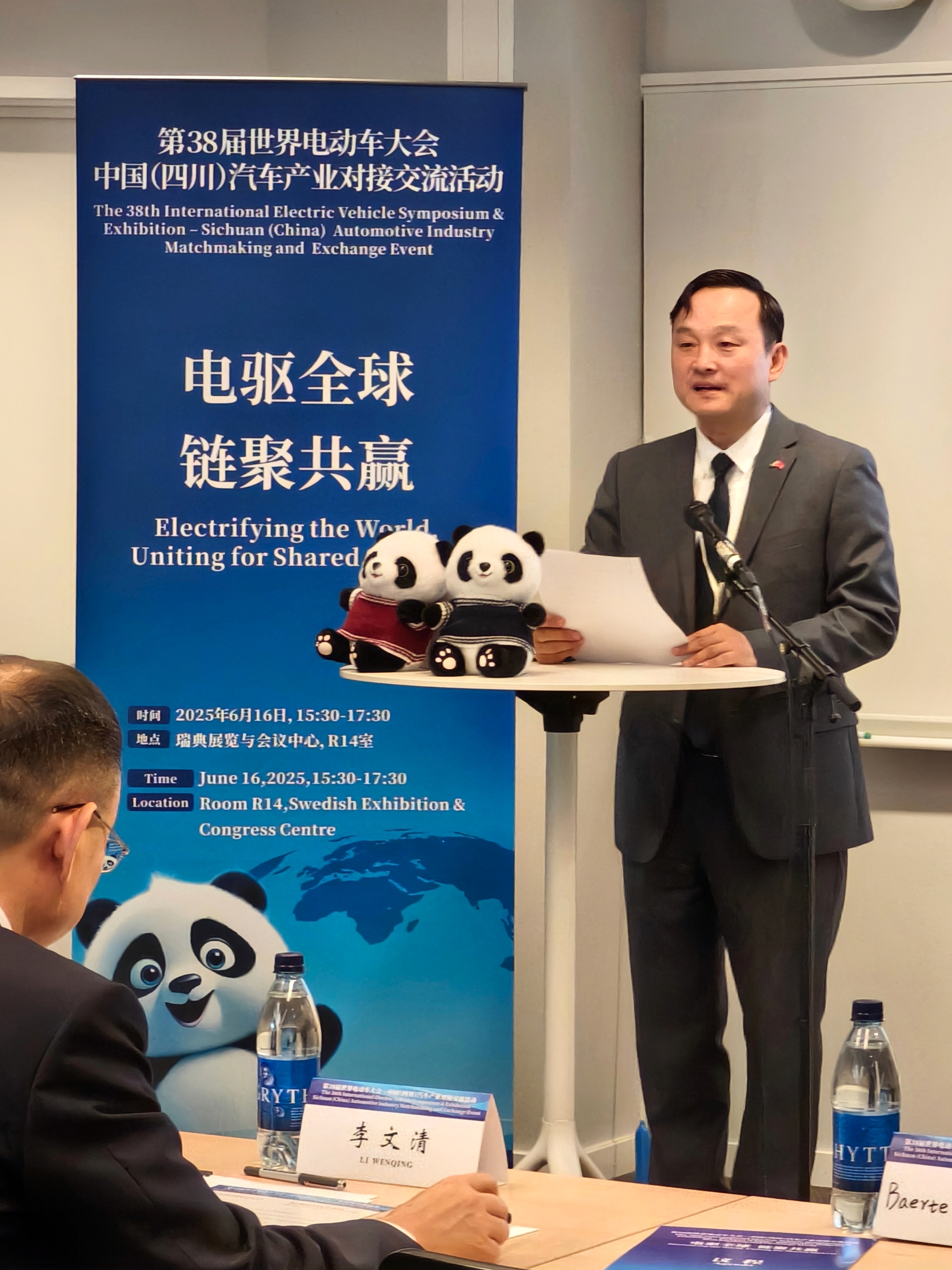
Vice Governor Li Wenqing, Mr. Baerte De Brey, Ms. Maria Leffler, distinguished guests, ladies and gentlemen,
It is a profound honor for me to represent the Consulate General of China in Gothenburg at the Sichuan Automotive Industry Exchange Event. First, I would like to extend a warm welcome to the delegation from Sichuan Province who have traveled from afar, and express my highest respect to all friends who have long been committed to promoting practical cooperation between China and Sweden and advancing the green development of the automotive industry.
Today, China is comprehensively advancing high-quality development. In 2024, China's GDP grew by 5%, contributing about 30% to global economic growth, making it a primary engine for the world’s economic development. China remains steadfast in advancing high-level opening up, striving to create a market-oriented, law-based, and world-class pro-business environment, and actively providing broader cooperation opportunities for enterprises from all countries, including Sweden.
China's new energy vehicle (NEV) industry has developed rapidly, establishing a complete and efficient industrial chain covering basic materials, components, vehicles, and manufacturing equipment. China supplies 70% of the world’s battery materials and 60% of its power batteries. Chinese companies have achieved internationally leading technologies in areas such as battery technology, autonomous driving, and vehicle connectivity, setting the direction for the industry's development. Currently, China has built over 12 million charging piles and more than 4,400 battery swap stations, forming the world's largest charging network. Fast-charging technology, which enables 80% charging in 15 minutes, has entered mass production.
For 15 consecutive years, China has been the world's largest automotive market in both production and sales. In 2024, China's automobile production and sales both exceeded 31 million units, setting a new historical record. Among these, NEV sales reached 12.87 million units, accounting for 40.9% of total sales. NEVs have become the "first choice" for an increasing number of consumers, with strong momentum in market share growth. In May 2025, the retail penetration rate of NEVs in China's passenger vehicle market exceeded 50%.
Looking back, Sweden was one of the first Western countries to establish diplomatic relations with the People's Republic of China. China and Sweden share highly complementary innovation philosophies and industrial strengths, and both are staunch supporters of multilateralism and free trade. Over the 75 years since establishing diplomatic ties, bilateral relations have steadily developed, and economic and trade cooperation has deepened continuously. China and Sweden are each other’s largest trading partners in Asia and Northern Europe, respectively. According to incomplete statistics, over 500 Swedish companies operate in China, and nearly 10,000 Swedish enterprises engage in trade with China. At the same time, an increasing number of Chinese companies are investing and establishing businesses in Sweden.
In the electric vehicle sector, Geely and Volvo have deepened collaboration by sharing vehicle platforms, engine technologies, and joint procurement of components, achieving economies of scale and accelerating the development of next-generation electric vehicles. BYD electric buses have successfully served public transportation systems in several Swedish cities and regions, including Skåne. Yutong electric buses have been selected as airport shuttles at Stockholm's main airport. NIO is building a network of battery swap stations in cities such as Stockholm and Gothenburg. Since 2024, the 7th China-Sweden Joint Committee Meeting on Scientific and Technological Cooperation and the 21st China-Sweden Joint Committee Meeting on Economic and Trade Cooperation have been held. Both sides agreed to establish a China-Sweden Green Transition Investment Working Group to collaborate in green development and technological innovation.
Ladies and gentlemen,
The global automotive industry is undergoing profound transformation. Electrification, low-carbon development, and intelligence have become irreversible trends. Looking ahead, we are confident that by deepening cooperation in this field, China and Sweden can achieve mutual benefit and win-win outcomes at a higher level, better serving the people of both countries and contributing to the green transition of the transportation industry and addressing global climate change challenges.
In closing, I wish this exchange event a complete success. Thank you!